Jul 12, 2014

Nikolai Sereda (Tenor) (Ukraine 1890 - Leningrad 1948)


                                                                 Lensky

In 1925, he finished the Moscow conservatoire in the class of G. Gandolfi. Sereda perfected his singing in Italy and Germania. During 1925-35, he sang at diverse theatres in Russia and duing 1935 -1948 sang at the Mariinski. Among his best roles were: Lenski, Levko, Berendei, Vladimir Dubrovski, Duca, Alfred, and Almaviva. 

Chronology of some appearances

1926-1933 Kharkov Opera House
1933-1935 Sverdlovsk Opera House

RECORDINGS FOR SALE


I wish to thank Aleksei Damaev for providing me this records

Demon (Rubinstein): Sinodal's scene
The Tsar's Bride (Rimsky-Korsakov): Aria of Lykov


Jul 11, 2014

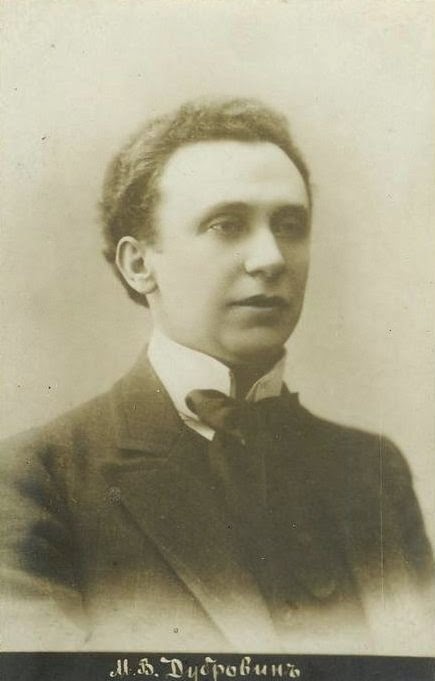
Mark Dubrovin (Tenor)


                                                               Hermann

In 1893 he appeared at the St. Petersburg Private Opera. From 1905 to 1908 and in the 1911-1912 season he performed at the S. Zimin's Opera House in Moscow. In 1909 he sang at the Sergievsky National House. In 1912 and 1913 he made guest appearances at Kharkov (also 1915-1917), Ekaterinoslav, Nizhny Novgorod, Saratov (1915). In the 1913-1914 season he sang at the National House in St. Petersburg.  Probably he retired from the stage in 1920.

Chronology of some appearances

1893 St. Petersburg Private Opera
1909 Moscow Sergievsky National House
1905-1908, 1911-1912 Moscow S. Zimin's Opera House
1913-1914 St. Petersburg National House

RECORDING FOR SALE


Gramophone Moscow  1908
Ernani (Verdi): O sommo Carlo with Vladimir Pikok, Lidya Milova and Oskar Kamionsky 022108 335m


Sergei Levik (Baritone) (White church, Kiev 1883 - St. Ptersburg 1967)


                                                               Amonasro

In 1907 he studied singing under the tenor Michail Medvdiev and in 1908 appeared in cocncert opposite italian opera singers. In the 1909-1912 season he sang at the National House of St. Petersburg, where he made his debut as Demon. From 1912 to 1916 he performed at the Theatre of Musical Drama at St. Ptersburg. He made guest appearances at Kharkov (1910), Kiev, Minsk, Moscow etc. He retired from the stage in 1923..

Chronology of some appearances

1909-1912 St. Petersburg National House
1912-1916 St. Ptersburg Theatre of Musical Drama


RECORDINGS FOR SALE


Gramophone, St Petersburg 27-10-10
Grand Requiem after the Battle of Borodino (It is not hailing, it is not raining) (words Kruglov) 4-22228 1815ae
Oh thou, quiet Father Don, Cossack song, 1812 (arr. Harteveld) 4-22224 1819ae

Pathé, St Petersburg 1910?
Demon (Rubinstein): Do not weep, oh child   2515
Demon (Rubinstein): Accursed world  2516

Lyrophon?
Aida (Verdi): Suo padre 


Jul 10, 2014

George Meader (Tenor) (Minneapolis, Minnesota, USA 1888 - Woodland Hills, Los Angeles, California, USA 1963)


He sang as a child in a boy's choir at Pittsburgh, then studied law at the University of Minnesota. He distinguished himself there also as a sportsman and sang at the University Glee Club. During the holidays at Germany his voice was discovered and he studied singing under Anna Schoen-Rene. In the 1907-08 season he made his debut at the Opera House of Leipzig as Steuermann in "Fliegenden Holländer". His concert debut was happened in 1908 at London. In 1910 he was engaged by the Court Theatre in Stuttgart; here he sang on 25. 10. 1912 in the premiere of Richard-Strauss’s opera ‘’Ariadne auf Naxos’’ in  the part of Scaramuccio. Also as a concert singer he was very successful. In 1913 he sang at Amsterdam in ‘’Lied von der Erde’’ of Gustav Mahler under Willem Mengelberg, the same year he appeared in the tenor part in Haydn’s ‘’Schöpfung’’ in Berlin in presence of the deutsch emperor Wilhelm II. in 1913 he took over in Berlin in  ‘’der Matthäuspassion’’ of J. S. Bach. Although he was an American, he could continue after the entry of the USA into the First World War in 1916 his career in Stuttgart. Thus he sang there in 1917 in the premiere of S. Wagner’s "An allem ist Hütchen schuld". Till 1919 he remained at Stuttgart and then returned to the USA. In 1919 he gave there the first concert at the Aeolian Hall  in New York. In 1920 he sang at New York in concert dedicated to the 150-th birthday of Beethoven. In 1921 he was engaged by the Metropolitan Opera at New York, where he sang till 1932. His beginning role at the Metropolitan Opera was the Victorin in the première of Korngold’s "Toter Stadt" (1921). He estimated himself especially as Tenor Buffo (David in "Meistersingern"). In 1922 he performed in the late première there of the Mozart's opera ‘’Così fan tutte’’ in the role of Ferrando. In 1922 he sang in the première of Rimsky-Korsakov’s ‘’Snow Maiden’’. In 1924 he sang at the guest performance of the Metropolitan Opera at Baden-Baden again the role of Ferrando in ‘’Così fan tutte’’. He appeared as a guest at Paris and Hamburg and gave 1926 song recitals at Berlin. After he had achieved a great success in 1931 in the operetta ‘’Boccaccio’’ of Suppé as a partner of Maria Jeritza, he completely turned to the operetta and became known at the New York Broadway. He appeared also in some Hollywood movies, among other things in ‘’The Great Caruso’’ and sang as a soloist at the Saint Thomas Church in New York. Later he lived at Hollywood.

Chronology of some appearances

1907-1908 Leipzig Opera House
1910-1919 Stuttgart Court Theatre
1921 New York Metropolitan Opera


RECORDINGS FOR SALE


Gramophone, Berlin 1913-08-22
Faust (Gounod): Es ist schon spät with Runge 2-944176 12834r
Faust (Gounod): O Mondenschein with Runge  2-944177 12835r
Trovatore (Verdi): In uns're Heimat with Herrmann 2-944085 12841r


Caspar Koch (Tenor) (Köln 1889 - Köln 1952)


I wish to thank Peter Thelen for providing me photos

After his education which took place in Cologne he was engaged in the 1917-26 seasons by the Opera House in Cologne. In the 1927-28 season he worked at the Opera House of Dusseldorf; in 1927 he appeared at the Bayreuth Festival as Froh in R. Wagner's ''Rheingold''. In the 1927-28 season he sang at the Berlin Kroll Opera. In 1928 he performed there the title part in the German première of I. Stravinsky's ''Oedipus Rex''. His other stage roles were Tannhäuser, Parsifal, Max in ''Freischütz'',  Canio in ''Pagliacci'' and Turiddu in ''Cavalleria Rusticana''. He retired from the stage in 1928 and worked since then as a pedagogue in Cologne.


Chronology of some appearances

1917-1926 Cologne Opera House 
1927 Bayreuth Festival
1927-1928  Dusseldorf  Opera House
1927-1928 Berlin Kroll Opera

RECORDINGS FOR SALE


Vox, Berlin 1922
Meistersinger von Nürnberg (Wagner): Am stillen Herd 03141 407A
Walküre (Wagner): Ein Schwert verhieß mir der Vater 03140 410A
Meistersinger von Nürnberg (Wagner): Morgenlich leuchtend 03141 411A
Fliegende Holländer (Wagner): Mit Gewitter und Sturm 03140 413A

Vox, Berlin 1924?
Madama Butterfly (Puccini): Im weiten Weltall 3311
Cavalleria Rusticana (Mascagni): Siciliana (O Lola) 3311

Carl Clewing (Tenor) (Schwerin 1884 – Badenweiler 1954)


At first he became an actor and worked at the Municipal Theatres of Bromberg and Strasbourg as well as from 1911 to 1920 at the Royal Theatre in Berlin. Since 1917 he studied singing under Francisco d'Andrade, Wilhelm Grüning, Ernst Grenzebach and Wilhelm Flam in Berlin.  Probably he made his debut in 1920 and in 1922 he was engaged by the Berlin State Opera. In the 1924-25 season he sang at the Bayreuth Festival in R. Wagner’s ‘’Meistersingern’’ and ‘’Parsifal’’. In 1925 he appeared at the Vienna premiere of  F. Lehár’s operetta ‘’Paganini’’ in the Johann Strauss-Theatre. In 1911 he appeared in the German film ‘’Der fremde Vogel’’. Already in 1926 he retired from the stage and became a lecturer of music science at Berlin, since 1929 he was a professor at the Vienna Music Academy. From 1932 to 45 he been in office as an artistic production manager of the sound record company  Telefunken. He was famous music researcher and publisher of folk songs.

Chronology of some appearances

1922 Berlin State Opera
1924 Bayreuth Festival
1925 Vienna Johann Strauss-Theatre


RECORDING FOR SALE


Gramophone
Verstehst Frankischer Spinnstubenlied  4-42411  15245
Der Tod von Basel, nach Marians Basler Totentanz 4-42410 15251

Vox
Tannhäuser (Wagner): Inbrunst im Herzen 769A 


Jul 8, 2014

Rosetta Pampanini (Soprano) (Milano 1896 - Corbola 1973)


                                                               Cio-Cio-San

She was born in Milan into a musical family. She initiallly trained to become a teacher but eventually decided to study voice. She was taught by the couple Emma and Lorenzo Molajoli and made her debut in 1920 at the Teatro Nazionale in Rome as Micaela. Subsequently she appeared at numerous Italian opera houses. In the first years of her career she built up her repertory under Tullio Serafin’s guidance. Of great importance was her association with Pietro Mascagni who often conducted her in his opera Iris. Pampanini’s success in the role re-established the piece from 1898 in the contemporary repertoire. Another significant mentor was Arturo Toscanini. He conducted the revival of Puccini’s Madame Butterfly at La Scala in 1925, with Rosetta Pampanini in the title role. The 12 performances turned out to be a complete triumph - not least because of the heroine whose artistry ensured that Madame Butterfly soon became one of the most popular operas. Not only did Pampanini help to establish Madame Butterfly, the role of Cio-Cio-San also made her to one of the most splendid Italian artists of the time. She remained at La Scala as long as Toscanini stayed there (until 1930), appearing in a number of world premieres of then contemporary operas as well as in her Puccini repertoire. She also toured with the Scala ensemble. Toscanini invited her to Berlin to sing Manon Lescaut and Madame Butterfly (1929). Covent Garden saw her in her Puccini parts. From 1926 she was a regular guest at the Teatro Colón in Buenos Aires. In the season 1931/32 she was engaged as Butterfly, Nedda and Mimì at the Chicago Opera, but was not reinvited later. Further performances at the opera houses of Vienna (1930-1932), Oslo (1933) and Prague (1935) followed. A special occasion was her performance of Mimì in a performance of La Bohème, conducted by Pietro Mascagni in Puccini’s home town Torre del Lago. From 1937 she turned to more dramatic roles such as Leonora in La Forza del destino, Aida and Maddalena. Rosetta Pampanini bade farewell to the stage in 1946. After her retirement she worked as a singing coach.

Chronology of some appearances

1920 Rome Teatro Nazionale Carmen  (Micaela)
1925 Milan La Scala Madame Butterfly (Cio-Cio-San)
1926 Buenos Aires Teatro Colón  (-)
1931 Chicago Chicago Opera (-)

RECORDINGS FOR SALE


Fonotipia, Milano 1926-04-08
Wally (Catalani): Ebben? Ne andrò lontana 152034 Pho5694
Manon Lescaut (Puccini): In quelle trine morbide 152035 Pho5695
Madama Butterfly (Puccini): Un bel dì, vedremo 74975 XXPh5696

Fonotipia, Milano 1926-04-09
Bohème (Puccini): Sì, mi chiamano Mimì 74976 XXPh5701
Otello (Verdi): Canzone del salce 74985 XXPh5705

Fonotipia, Milano 1926-04-10
Iris (Mascagni): Un dì 74986 XXPh5708
Otello (Verdi): Ave Maria unpubl. Pho5709

Fonotipia, Milano 1926-04-12
Carmen (Bizet): Io dico, no, non son paurosa 74989 XXPh5710
Tosca (Puccini): Vissi d'arte unpubl. Pho5711
Andrea Chénier (Giordano): La mamma morta 74990 XXPh5712

Fonotipia, Milano 1926-10-20
Bohème (Puccini): O soave fanciulla with Aureliano Pertile 120001 XXPh5775

Fonotipia, Milano 1926-10-26
Turandot (Puccini): Signore, ascolta 168014 Pho5789
Turandot (Puccini): Tanto amore segreto... Tu che di gel sei cinta 168015 Pho5790
Otello (Verdi): Ave Maria 168038 Pho5792

Fonotipia, Milano 1927-01-20
Pagliacci (Leoncavallo): Stridono lassù 168038 Pho5854
Faust (Gounod): C'era un re, un re di Thulé 120039 XXPh5855

Fonotipia, Milano 1927-01-24 
Madama Butterfly (Puccini): Un bel dì, vedremo 120043 XXPh5873
Wally (Catalani): Ebben? Ne andrò lontana 120043 XXPh5874

Fonotipia, Milano 1928-01-11
Manon Lescaut (Puccini): In quelle trine morbide 168191 Pho6096
Andrea Chénier (Giordano): La mamma morta 120165 XXPh6098

Fonotipia, Milano 1928-05-19
Madama Butterfly (Puccini): Bimba non piangere with Ferdinando  Ciniselli 120148  XXPh6239 
Madama Butterfly (Puccini): Quest'obi pomposa with Ferdinando Cinizelli 120148 XXPh6240

Fonotipia, Milano 1928-05-21
Madama Butterfly (Puccini): Adesso voi with Ferdinando  Ciniselli 120149 XXPh6247
Madama Butterfly (Puccini): Via dall'anima in pena with Ferdinando  Ciniselli 120149 XXPh6248


Jul 6, 2014

Francisco (Augustin) Nuibo (Tenor) (Marsiglia 1874 - Nizza 1948)


He studied at the conservatoire of Marseille under Boudouresque, then in Paris under the famous tenor Victor Capoul. He made his debut at the Grand Opéra of Paris in 1900 as Fischer in G. Rossini’s ‘’Wilhelm Tell’’. Till 1908 he appeared at the Grand Opéra, where in 1907 sang in the premiere of the opera ‘’La Catalane’’ of  Fernand Le Borne. In the 1904-05 season he was a member of the Metropolitan Opera in New York (beginning role: Turiddu in ‘’Cavalleria Rusticana’’), afterwards North America tour. By request of the manager of the Metropolitan opera he changed his name and performed as Francisco Nuibo. He performed at the Metropolitan Opera with success also in Sunday Night Concerts. In 1908 he joined to the Opéra-Comique of  Paris and sang later at the Théâtre Lyrique in Paris. In 1913 he appeared at the Théâtre des Champs-Elysées of Paris in the opera ‘’Les trois masques’’ of Isidore de Lara. He made guest appearances at the Covent Garden in London, Lisbon, Mexico City, San Francisco and Havana. He also had a significant career at the famous French provincial theatres. In 1923 he founded a conservatoire in the Paris Montmartre.

Chronology of some appearances

1900-1908 Paris Grand Opéra 
1904-1905 New York Metropolitan Opera
1908 Paris Opéra-Comique
1913 Paris Théâtre des Champs-Elysées

RECORDINGS FOR SALE


Pathé cylinders & discs, Paris 1903?
Le crédo d'amour (Luigini) 0371

Columbia cylinders, New York 1905
Carmen (Bizet): Romance de la fleur 32716

Columbia, New York 1905
Martha (Flotow): Air des larmes 3127
Carmen (Bizet): Romance de la fleur 3128
Roméo et Juliette (Gounod): Ah! lève-toi soleil 3129

Pathé, Paris 1906/1907
Noël d'amour (Luigini) 4574
Manon (Massenet): Le rêve 4578


Antonio Sabellico (Bass) (Campo Morto/Nettuno (oggi Campo Verde/Aprilia) 1858 - Roma 1934)


                                                Contratto Teatro di Torino 1915

He studied singing under the pedagogue Parisotto and made his debut around 1880 in ‘’Forza del Destino’’ at Rome.

Chronology of some appearances

1887    Roma   Teatro Argentina Dannazione di Faust (Brander)
1890    Messina Teatro Vittorio Emanuele Ugonotti (Saint-Bris)                                
1893    Napoli  Teatro San Carlo Lohengrin (Re Enrico)
1896    Cagliari Teatro Civico Roberto il Diavolo (Bertramo)
1900    Piacenza Teatro Municipale  Lohengrin (Re Enrico)
1903    Bucarest Teatro Nazionale Puritani (Giorgio)
1906    Piacenza Teatro Municipale  Mefistofele (Mefistofele)
1908    Cairo Teatro Abbas Aida (Ramfis)
1913    Firenze Politeama Nazionale Ernani (Silva)
1915    Casale Monferrato Politeama  Favorita (Baldassarre)
1918    Siena Teatro Dei Rinnovati  Barbiere di Siviglia (Don Basilio)
1922    Savona Teatro Chiabrera Barbiere di Siviglia (Don Basilio)
1924    Asti Teatro Alfieri Boheme (Colline)
1926    Trapani Teatro Garibaldi Gioconda (Alvise)
1927    Bologna Teatro Del Corso Tosca (Angelotti)

RECORDINGS FOR SALE


Pathé - AICC cylinders & discs, Milano 1903?
Faust (Gounod): Dio dell'or 84083, 10204
Favorita (Donizetti): Splendon più belle (w. chorus) 84084
Sonnambula (Bellini): Vi ravviso (w. chorus) 84089
Mosè (Rossini): Dal tuo stellato soglio 84090

Zonophone, Milano 1904-12
Favorita (Donizetti): Splendon più belle (w. chorus) X-92018
Bohème (Puccini): Vecchia zimarra 92039


Adele Ponzano (Mezzo-Soprano)


She studied in Turin under Annetta Casaloni, the first interpreter of Maddalena in ''Rigoletto''. She made her debut in 1902 at the Teatro Politeama of Saluzzo in ''Frà Diavolo''.

Chronology of some appearances

1898 Saluzzo Politeama  Fra' Diavolo (Pamela)
1903 Alessandria d'Egitto Teatro Zizinia Carmen (Mercedes)            
1907 Milano Teatro La Scala  Wally (Afra)
1910 Ravenna  Teatro Alighieri Walkiria (Fricka)
1913 Venezia   Teatro La Fenice Otello (Emilia)
1916 Milano  Teatro Dal Verme Forza del Destino (Preziosilla)
1919 Cremona  Politeama Verdi  Trovatore (Azucena)
1923 Cesena Teatro Comunale Gioconda (Laura)
1927 Palermo  Teatro Biondo Gioconda (Laura)
1928 Genova Teatro Carlo Felice  Matrimonio Segreto (Fidalma)

RECORDINGS FOR SALE


Odeon Fonotipia, Milano
Barbieri di Siviglia (Rossini): Il vecchietto cerca moglie 37494


Edison, Milano
L’amico Fritz (Mascagni): Lacere miseri Unpubl. 44595


Ida Rappini (Mezzo-Soprano) (Bologna ? - ?)


She studied singing at the Liceo Musicale of Bologna. She made her debut in 1890 at the Teatro Sociale of Cento in ‘’Don Sebastiano’’.

Chronology of some appearances

1890 Cento Teatro Sociale Don Sebastiano (Zaida)
1892 Milano Teatro La Scala  Rigoletto (Maddalena)
1894 Genova   Teatro Carlo Felice Guglielmo Tell (Edwige)
1896 Milano Teatro La Scala  Carmen (Carmen)
1899 Bergamo Teatro Donizetti Carmen (Carmen)
1902 Imola Teatro Comunale Mignon (Federico)
1906 Ravenna  Teatro Mariani Rigoletto (Maddalena)
1922 Livorno Teatro Goldoni Matrimonio Segreto (Fidalma)

RECORDINGS FOR SALE


Fonotipia, Milano 1911-01-27
Don Debatiano (Donizetti): Terra adorata dei Padre miei 92776 XPh4507

Fonotipia, Milano 1914-04-27
Parisina (Mascagni): Sequenza delle tre donzelle with Solari and del Lungo 69136 Xph5064


Jul 4, 2014

Mirko Štork (Tenor) (Praha 1880 – Praha 1953)


                                                                 Lorenzo

He was active first as an employee. His education occurred autodidactically and he was promoted by musicologist Otokar Sourek. After his appearances at first in Prague and in the surroundings of this town as a concert singer, he made his debut in 1904 at the Prague National Theatre as Grechineux in ‘’Les cloches de Corneville’’ of Planquette. After some other guest performances he was engaged in 1906 by the National Theatre in Prague and remained in this house till 1936. He appeared in Prague also in several premieres of operas, thus in 1905 in ‘’Jessica’’ of J. B. Forester and in 1916 in ‘’Karlstein’’ of  V. Novák; on 23. 4. 1920 he sang there the title part in the premiere of L. Janácek’s ‘’Ausflüge des Herrn Broucek’’. Guest performances led him, above all as Wenzel in ‘’Verkauften Braut’’ to Stockholm, Warsaw, Vienna, Bucharest and in 1933 to Chicago.

Chronology of some appearances

1904-1936 Prague National Theatre

RECORDINGS FOR SALE


Odeon, Praha 1907/10
Prodaná nevěsta (Smetana): Zńam jednu dívku with Huml 38737 Zx202
Prodaná nevěsta (Smetana): Věrné milování with Ungrová 38738 Zx206
Prodaná nevěsta (Smetana): Utiš se, dívku 48130 Zx473
Prodaná nevěsta (Smetana): V studni with Kliment 48121 Zx418